
The Russell Group Menu Leaderboard 2026
Which top UK universities are making the sustainable choice the easy choice on their menus?
Catering teams are often keen to support sustainability goals while still giving their customers what they want. Research shows that what people choose to eat is often influenced by how options are presented. Simple, low-cost changes to menu design can make low-carbon, plant-based choices more visible and appealing; giving foodservice the opportunity to help customers choose plant-based dishes because they want to, not because they have to.
Universities, as places of science, learning and progress, have long led the charge in sustainable innovation and their catering teams have great potential to influence others in the food sector, while also setting up students for a lifetime of healthy, low-carbon eating. This leaderboard highlights how Russell Group universities are already using, or could begin to use, menu design to make plant-based dishes more desirable, to ultimately encourage more sustainable dining choices.
By showcasing good practice and identifying opportunities for improvement amongst the UK’s top research institutions, we aim to support more foodservice professionals to understand and unlock the power of menu design.
After all, every dining choice starts with a menu. And the people who design those menus may be among the most influential change makers in the food system.
The Leaderboard
Where universities received the same overall menu score, their ranking was determined by their Products-a-plenty score, as this is the most influential nudge category (see below for more information).
Why score menus?
Encouraging diners to choose plant-based options isn’t just about adding an extra salad to a menu. It requires a clear understanding of the behavioural science behind food choices and for food service operations to implement a range of different behaviour change techniques that are effective at influencing these choices in a different, intended direction.
Most dining decisions are made quickly and are influenced by habit, menu layout, and how a dish is described or promoted. By using simple ‘nudges’ or subtle changes to menus, food outlets can easily make plant-based eating the most appealing and ‘normal’ choice without restricting diners’ sense of freedom to choose or reducing their satisfaction.
What is nudge theory?
Nudge theory is a behavioural science concept that involves making subtle changes to how choices are presented to encourage particular decisions without removing choice.
Evidence shows that menu design can play a powerful role in shaping dining choices, making nudge theory a valuable tool for universities seeking to promote more sustainable eating habits while maintaining customer choice and satisfaction.
The science behind the scores
Forward Food partnered with Behavior Global, a behavioural science consultancy, to develop a menu scoring tool grounded in the latest research on food choice behaviour.
The tool measures how effectively proven psychological levers are being used on menus to drive positive change.
Together, we identified and weighted the menu interventions shown to be most effective at encouraging plant-based choices.
How were menus scored?
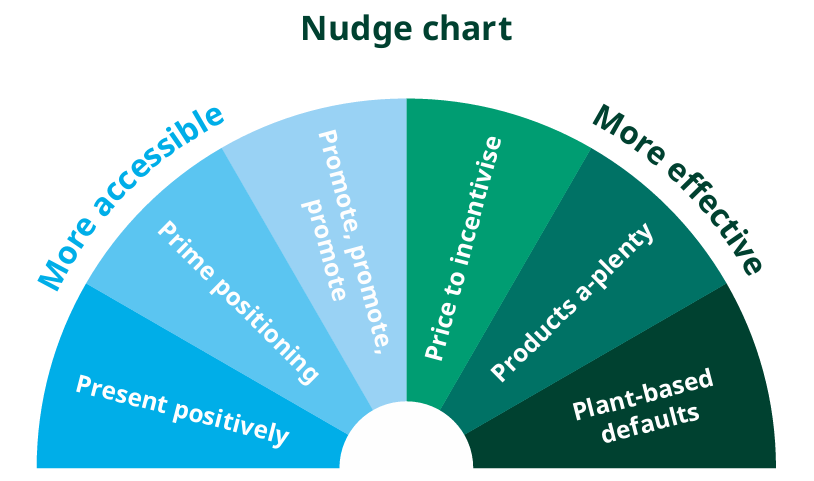
Universities were assessed across five evidence-based behaviour change categories, the 5 Green Ps, which relate to plant-based availability, positioning, positive language, promotion and pricing. Each category represents a cluster of techniques proven to shift diners away from high-carbon, meat options, when eating out-of-home.
Products-a-plenty
Food service organisations can increase uptake of plant-based options by offering a wide range of high-quality, tasty and appealing plant-based dishes. In particular, presenting these options as the default choice on the menu can enhance uptake by making their selection easier, more visible and by signalling that they are the normal or acceptable option for most diners rather than a specialist request.
This category assesses:
- Availability of plant-based items
- Variety of plant-based options
- Perceived quality of plant-based options
Present positively
Describing plant-based menu items using attractive and appealing terminology is important to signal to customers that these items are desirable choices. This is especially helpful to encourage individuals who might habitually choose animal-based options to consider alternatives they might not otherwise select.
This category assesses:
- Use of indulgent language to describe plant-based vs. animal-based options
- Use of off-putting, restriction-focused language on plant-based items (i.e. ‘vegan’, ‘meat-free’ etc.)
- Presence of discreet labelling for plant-based items
Prime positioning
Placing plant-based choices in the most visible and prominent positions on a menu is an important way to ensure that diners notice and consider these options. This includes positioning plant-based dishes alongside meat options within the main choice set, rather than isolating them in a separate box or menu section.
This category assesses:
- Integration of plant-based items into the main body of the menu
- Listing plant-based items first on the menu
Promotions
Actively promoting the benefits of plant-based items is a tactic to encourage diners to try these dishes by showcasing their positive elements. This can include indicating that plant-based options are recommended by a trusted source, highlighting their popularity, or emphasising benefits that consumers consider to be added value, such as the presence of particular nutrients, like fibre or protein, other health-giving properties, like energy-boosting, or that plant-based items are seasonal and locally sourced.
This category assesses:
- Use of recommendations
- Use of labels indicating popularity
- Use of benefit-focused labels
- Use of imagery
Promotions score interpretation
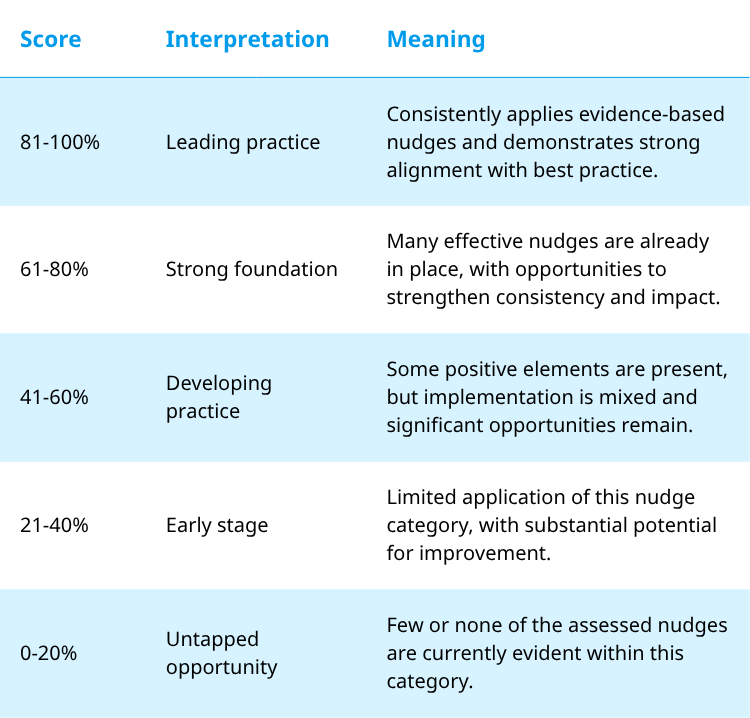
This category score should be interpreted differently to other categories as it works directionally.
A score of 40% indicates no overall advantage in either direction, which may reflect either an absence of promotional cues or opposing effects that balance out. Scores below 40% indicate an overall advantage for animal-based choices, while scores above 40% indicate increasing overall support for plant-based choices.
Price to incentivise
The final category in the tool focuses on the price of plant-based items on the menu. Ideally, plant-based items should be offered at a lower price point than equivalent animal-based dishes, or at least price parity to incentivise their sale. Overall, selecting plant-based options should not result in a financial penalty or surcharge as this would naturally deter many customers from choosing them.
This category assesses:
- Price differences between default plant-based dishes and their equivalent animal-based options
- Discounts and/or surcharges on plant-based swaps
Price to incentivise score interpretation
Similar to Promotions, this category score should be interpreted differently to other categories as it works directionally.
A score of 40% indicates no overall price advantage in either direction, which may reflect price parity or plant-based price advantages and disadvantages that balance out. Scores below 40% indicate that pricing overall tends to disadvantage plant-based choices, while scores above 40% indicate an increasing overall price advantage for plant-based choices.
Overall menu score
Not all nudges influence food choices equally. To reflect this, the overall score uses weightings based on research evidence that give greater importance to interventions that show the strongest impact on customer behaviour.
The weightings were developed by Behaviour Global based on findings from a meta-analysis by Paul Lohmann et al. (2026). As a result, Products-a-plenty has the greatest influence on the final score, followed by Prime positioning, Price to incentivise, Present positively, and Promotions.
Average scores
Products-a-plenty
score
Present positively
score
Prime positioning
score
Promotions
score
Price to incentivise
score
Turn insights into action
Join our webinar to unpack the findings from this Russell Group leaderboard, learn which menu nudges have the greatest impact on food habits, and explore practical steps to make plant-based options the easiest choice.
FAQs
Interested in working with us?
We offer a wide variety of resources to make your plant-forward initiatives a success. From culinary toolkits and recipes, to product lists, baking swaps, menu guidance and more; we help you reach your sustainability goals
– all at no cost to you.